Clipping - Dead Channel Sky - New 2 LP Record 2025 Sub Pop Loser Edition Ghostly Green Vinyl - Hip Hop / Industrial / Experimental
Because of their mix of hellified gangster shit and progressive compositions, I once jokingly called Clipping “Deathrow Tull.” Well, it’s not a joke anymore. While their last few projects have been record-long concepts like the classic prog rock of old, Dead Channel Sky is mixtape-like, a carefully curated collection of songs in which every track is a love letter to a possible present. Like a mashup of distinct elements, the overall concept is there, but the result is brief glimpses into a world rather than an overview of it. It sounds crisp and classic at the same time. When something strikes us as retrospective and futuristic at the same time, it’s a reminder of how slipshod our present moment truly is.
In my book Dead Precedents: How Hip-Hop Defines the Future, I draw what Walter Benjamin would call correspondences between early hip-hop culture and cyberpunk literature, the binary stars of the solar system at the end of the millennium. I exploit their similarities to illustrate how the cultural practices of hip-hop have informed the cultural practices of the now. Hip-hop was borne of the post-apocalyptic scene in the South Bronx in the early 1970s. Its repurposing of outmoded technology, the hand-styled hieroglyphic screennames on every colorfast surface, and the gyrating dance moves—an entire culture forged from the freshest of what was available at hand—mirrors the post-apocalyptic techno-scrounge of William Gibson’s Neuromancer, Rudy Rucker’s Software, and other early works by the contributors to Bruce Sterling’s Mirrorshades anthology (Pat Cadigan, John Shirley, Lewis Shiner, and Sterling himself, among others). Add the leather-clad mohawks of Afrika Bambaataa and the Soulsonic Force or Rammellzee’s B-boy battle armor and a blend of the two comes further into focus.
Juxtaposing high-tech, corporate command-and-control systems (the “cyber”) with the lo-fi, D.I.Y. underground (the “punk”), cyberpunk proper starts in 1982 and ends in 1999, from Blade Runner to The Matrix. There are works before and works since that embody the visions and values of cyberpunk, but these dates act as rough parameters for their assimilation into the larger social sphere, for the time it took cyberpunk to become cyberculture. In the meantime, hip-hop matured, went through its Golden Era, then melted into further forms. Over the same decades, it went from “Planet Rock” to “Bring da Ruckus” to “Hard Knock Life,” from Fab 5 Freddy to Public Enemy to Missy Elliott, from Run-DMC to N.W.A. to Notorious B.I.G. While other genres flirted with it, hip-hop was fickle and fey. Any tryst with the odd bedfellow was a one-night stand at best. Rap and rock birthed mutant offspring maligned by most, and hip-hop’s relations with electronica rarely fared any better.
Those twin suns—hip-hop and cyberpunk—both rose in the 1970s and warmed the wider world during the 1980s and 1990s. What if someone explicitly merged them into one set and sound? After all, both movements are the result of hacking the haunted leftovers of a war-torn culture that’s long since moved on.
On Dead Channel Sky, Clipping texture-map the twin histories of hip-hop and cyberpunk onto an alternate present where Rammellzee and Bambaataa are the superheroes of old; where Cybotron and Mantronix are the reigning legends; where Egyptian Lover and Freestyle, are debated endlessly, and Ultramag and Public Enemy are the undeniable forefathers; where the lost movements of 1980s and the 1990s are still happening: rave, trip-hop, hip-house, acid house, drum & bass, big beat—the detritus of a different timeline, the survivors of armed audio warfare. That war at thirty-three and a third, its atrocities imprinted upon yet another generation, what someone once called, “the presence of the significance of things” without a hint of ambiguity.
Clipping are very story oriented. They deal in ontology and narrative as much as beats and rhymes. They’ve been approaching making music like writing science fiction since the band’s conception. Two of their records have been nominated for Hugo Awards (one of science fiction’s top literary prizes), and a novella spun-off from their music was nominated for a third. As Clipping, they’ve collaborated with as many of their fellow experimental noise artists as they have fellow rappers. Here those co-conspirators include everyone from the guitarist Nels Cline on the outro to “Dodger” (titled “Malleus”) to their labelmates Cartel Madras on “Mirrorshades, pt. 2,” rapper/actor Tia Nomore on “Scams,”as well the wordy wordsmith Aesop Rock on “Welcome Home Warrior.” Diggs is known for intricate lyrics and rapid-fire rapping, and the tracks that Snipes and Hutson build in the background are no less complex. On “Code,” they sample narrated memories from the Afrofuturist documentary The Last Angel of History; and on “Dominator,” they repurpose a line from the classic Dutch hardcore track “Dominator” by Human Resource. All of the above serves to give us a glimpse of an adjacent possible present, where hip-hop and cyberpunk are one culture.
Binary stars are often perceived as one object when viewed with the naked eye. Like those twin sun systems, it’ll take some special equipment and some discerning attention to pull the stars apart on this record. As Diggs barks on the fire-starting “Change the Channel”: Everything is very important!
Product Information
Product Information
Shipping & Returns
Shipping & Returns
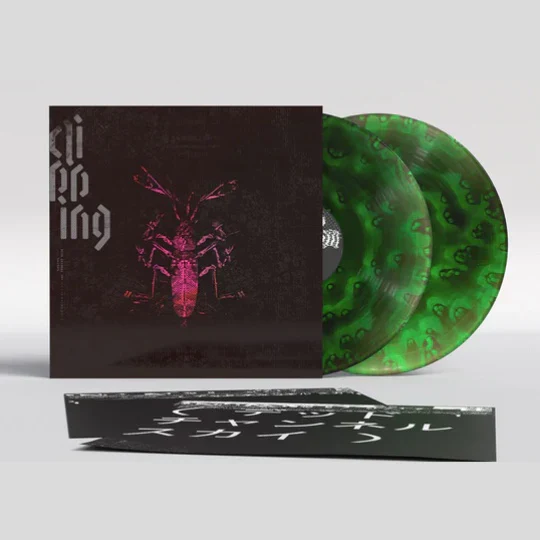
Clipping - Dead Channel Sky - New 2 LP Record 2025 Sub Pop Loser Edition Ghostly Green Vinyl - Hip Hop / Industrial / Experimental
Clipping - Dead Channel Sky - New 2 LP Record 2025 Sub Pop Loser Edition Ghostly Green Vinyl - Hip Hop / Industrial / Experimental
Because of their mix of hellified gangster shit and progressive compositions, I once jokingly called Clipping “Deathrow Tull.” Well, it’s not a joke anymore. While their last few projects have been record-long concepts like the classic prog rock of old, Dead Channel Sky is mixtape-like, a carefully curated collection of songs in which every track is a love letter to a possible present. Like a mashup of distinct elements, the overall concept is there, but the result is brief glimpses into a world rather than an overview of it. It sounds crisp and classic at the same time. When something strikes us as retrospective and futuristic at the same time, it’s a reminder of how slipshod our present moment truly is.
In my book Dead Precedents: How Hip-Hop Defines the Future, I draw what Walter Benjamin would call correspondences between early hip-hop culture and cyberpunk literature, the binary stars of the solar system at the end of the millennium. I exploit their similarities to illustrate how the cultural practices of hip-hop have informed the cultural practices of the now. Hip-hop was borne of the post-apocalyptic scene in the South Bronx in the early 1970s. Its repurposing of outmoded technology, the hand-styled hieroglyphic screennames on every colorfast surface, and the gyrating dance moves—an entire culture forged from the freshest of what was available at hand—mirrors the post-apocalyptic techno-scrounge of William Gibson’s Neuromancer, Rudy Rucker’s Software, and other early works by the contributors to Bruce Sterling’s Mirrorshades anthology (Pat Cadigan, John Shirley, Lewis Shiner, and Sterling himself, among others). Add the leather-clad mohawks of Afrika Bambaataa and the Soulsonic Force or Rammellzee’s B-boy battle armor and a blend of the two comes further into focus.
Juxtaposing high-tech, corporate command-and-control systems (the “cyber”) with the lo-fi, D.I.Y. underground (the “punk”), cyberpunk proper starts in 1982 and ends in 1999, from Blade Runner to The Matrix. There are works before and works since that embody the visions and values of cyberpunk, but these dates act as rough parameters for their assimilation into the larger social sphere, for the time it took cyberpunk to become cyberculture. In the meantime, hip-hop matured, went through its Golden Era, then melted into further forms. Over the same decades, it went from “Planet Rock” to “Bring da Ruckus” to “Hard Knock Life,” from Fab 5 Freddy to Public Enemy to Missy Elliott, from Run-DMC to N.W.A. to Notorious B.I.G. While other genres flirted with it, hip-hop was fickle and fey. Any tryst with the odd bedfellow was a one-night stand at best. Rap and rock birthed mutant offspring maligned by most, and hip-hop’s relations with electronica rarely fared any better.
Those twin suns—hip-hop and cyberpunk—both rose in the 1970s and warmed the wider world during the 1980s and 1990s. What if someone explicitly merged them into one set and sound? After all, both movements are the result of hacking the haunted leftovers of a war-torn culture that’s long since moved on.
On Dead Channel Sky, Clipping texture-map the twin histories of hip-hop and cyberpunk onto an alternate present where Rammellzee and Bambaataa are the superheroes of old; where Cybotron and Mantronix are the reigning legends; where Egyptian Lover and Freestyle, are debated endlessly, and Ultramag and Public Enemy are the undeniable forefathers; where the lost movements of 1980s and the 1990s are still happening: rave, trip-hop, hip-house, acid house, drum & bass, big beat—the detritus of a different timeline, the survivors of armed audio warfare. That war at thirty-three and a third, its atrocities imprinted upon yet another generation, what someone once called, “the presence of the significance of things” without a hint of ambiguity.
Clipping are very story oriented. They deal in ontology and narrative as much as beats and rhymes. They’ve been approaching making music like writing science fiction since the band’s conception. Two of their records have been nominated for Hugo Awards (one of science fiction’s top literary prizes), and a novella spun-off from their music was nominated for a third. As Clipping, they’ve collaborated with as many of their fellow experimental noise artists as they have fellow rappers. Here those co-conspirators include everyone from the guitarist Nels Cline on the outro to “Dodger” (titled “Malleus”) to their labelmates Cartel Madras on “Mirrorshades, pt. 2,” rapper/actor Tia Nomore on “Scams,”as well the wordy wordsmith Aesop Rock on “Welcome Home Warrior.” Diggs is known for intricate lyrics and rapid-fire rapping, and the tracks that Snipes and Hutson build in the background are no less complex. On “Code,” they sample narrated memories from the Afrofuturist documentary The Last Angel of History; and on “Dominator,” they repurpose a line from the classic Dutch hardcore track “Dominator” by Human Resource. All of the above serves to give us a glimpse of an adjacent possible present, where hip-hop and cyberpunk are one culture.
Binary stars are often perceived as one object when viewed with the naked eye. Like those twin sun systems, it’ll take some special equipment and some discerning attention to pull the stars apart on this record. As Diggs barks on the fire-starting “Change the Channel”: Everything is very important!
Original: $31.99
-65%$31.99
$11.20Product Information
Product Information
Shipping & Returns
Shipping & Returns
Description
Because of their mix of hellified gangster shit and progressive compositions, I once jokingly called Clipping “Deathrow Tull.” Well, it’s not a joke anymore. While their last few projects have been record-long concepts like the classic prog rock of old, Dead Channel Sky is mixtape-like, a carefully curated collection of songs in which every track is a love letter to a possible present. Like a mashup of distinct elements, the overall concept is there, but the result is brief glimpses into a world rather than an overview of it. It sounds crisp and classic at the same time. When something strikes us as retrospective and futuristic at the same time, it’s a reminder of how slipshod our present moment truly is.
In my book Dead Precedents: How Hip-Hop Defines the Future, I draw what Walter Benjamin would call correspondences between early hip-hop culture and cyberpunk literature, the binary stars of the solar system at the end of the millennium. I exploit their similarities to illustrate how the cultural practices of hip-hop have informed the cultural practices of the now. Hip-hop was borne of the post-apocalyptic scene in the South Bronx in the early 1970s. Its repurposing of outmoded technology, the hand-styled hieroglyphic screennames on every colorfast surface, and the gyrating dance moves—an entire culture forged from the freshest of what was available at hand—mirrors the post-apocalyptic techno-scrounge of William Gibson’s Neuromancer, Rudy Rucker’s Software, and other early works by the contributors to Bruce Sterling’s Mirrorshades anthology (Pat Cadigan, John Shirley, Lewis Shiner, and Sterling himself, among others). Add the leather-clad mohawks of Afrika Bambaataa and the Soulsonic Force or Rammellzee’s B-boy battle armor and a blend of the two comes further into focus.
Juxtaposing high-tech, corporate command-and-control systems (the “cyber”) with the lo-fi, D.I.Y. underground (the “punk”), cyberpunk proper starts in 1982 and ends in 1999, from Blade Runner to The Matrix. There are works before and works since that embody the visions and values of cyberpunk, but these dates act as rough parameters for their assimilation into the larger social sphere, for the time it took cyberpunk to become cyberculture. In the meantime, hip-hop matured, went through its Golden Era, then melted into further forms. Over the same decades, it went from “Planet Rock” to “Bring da Ruckus” to “Hard Knock Life,” from Fab 5 Freddy to Public Enemy to Missy Elliott, from Run-DMC to N.W.A. to Notorious B.I.G. While other genres flirted with it, hip-hop was fickle and fey. Any tryst with the odd bedfellow was a one-night stand at best. Rap and rock birthed mutant offspring maligned by most, and hip-hop’s relations with electronica rarely fared any better.
Those twin suns—hip-hop and cyberpunk—both rose in the 1970s and warmed the wider world during the 1980s and 1990s. What if someone explicitly merged them into one set and sound? After all, both movements are the result of hacking the haunted leftovers of a war-torn culture that’s long since moved on.
On Dead Channel Sky, Clipping texture-map the twin histories of hip-hop and cyberpunk onto an alternate present where Rammellzee and Bambaataa are the superheroes of old; where Cybotron and Mantronix are the reigning legends; where Egyptian Lover and Freestyle, are debated endlessly, and Ultramag and Public Enemy are the undeniable forefathers; where the lost movements of 1980s and the 1990s are still happening: rave, trip-hop, hip-house, acid house, drum & bass, big beat—the detritus of a different timeline, the survivors of armed audio warfare. That war at thirty-three and a third, its atrocities imprinted upon yet another generation, what someone once called, “the presence of the significance of things” without a hint of ambiguity.
Clipping are very story oriented. They deal in ontology and narrative as much as beats and rhymes. They’ve been approaching making music like writing science fiction since the band’s conception. Two of their records have been nominated for Hugo Awards (one of science fiction’s top literary prizes), and a novella spun-off from their music was nominated for a third. As Clipping, they’ve collaborated with as many of their fellow experimental noise artists as they have fellow rappers. Here those co-conspirators include everyone from the guitarist Nels Cline on the outro to “Dodger” (titled “Malleus”) to their labelmates Cartel Madras on “Mirrorshades, pt. 2,” rapper/actor Tia Nomore on “Scams,”as well the wordy wordsmith Aesop Rock on “Welcome Home Warrior.” Diggs is known for intricate lyrics and rapid-fire rapping, and the tracks that Snipes and Hutson build in the background are no less complex. On “Code,” they sample narrated memories from the Afrofuturist documentary The Last Angel of History; and on “Dominator,” they repurpose a line from the classic Dutch hardcore track “Dominator” by Human Resource. All of the above serves to give us a glimpse of an adjacent possible present, where hip-hop and cyberpunk are one culture.
Binary stars are often perceived as one object when viewed with the naked eye. Like those twin sun systems, it’ll take some special equipment and some discerning attention to pull the stars apart on this record. As Diggs barks on the fire-starting “Change the Channel”: Everything is very important!